
By Marty Hull. Photos by Rod Searcy.
The fastest we ever go in the water is when we push off the wall. The moment our feet leave the wall we begin to slow down. If upper body streamlining is excellent then push-off speed is carried out farther from the wall and we reach the surface while we are still moving very fast. Excellent streamlining allows a faster lap from start to finish.
What is excellent streamlining? A body that is as straight narrow and smooth as possible. All three of these can he improved by stretching.
World record holder Jeff Rouse has a streamline position that is one of the best in the world. Notice how straight his body is.
(Picture 1).
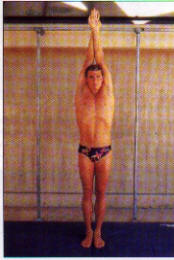
Also notice how he narrows his shoulders by moving his arms and shoulder blades up alongside and behind his head
(Picture 2).
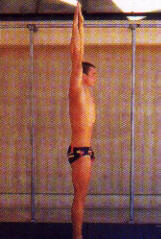
To take full advantage of what streamlining can offer you must he able to get to the most ideal streamlined position with extraordinary ease. The more resistance you encounter in your joints and muscles as you try to streamline the worse streamlining ability you will have especially late into a race.
Compare your flexibility to Rouse’s. When you extend your arms above your head are they in perfect alignment with your torso? Does your back arch when you extend your arms over your head? If your arms are not straight in line with your torso or if your back arches even the slightest amount this will ruin your streamlining.
Can you narrow your shoulders by moving your shoulder blades and arms up alongside and in behind your head? If you can’t then your streamlining will suffer significantly.
The secret to getting to this streamlined position with case is to increase the range of motion of your shoulder joints. Additional range of motion of the shoulder blade is what allows Rouse’s straight narrow smooth body shape.
To stretch the shoulder blade muscles it is necessary to use a pulling force on the hand or arm and to conduct this force safely along the arm through the shoulder joint to the shoulder blade.
This can be done by grabbing onto a post or pole with the hand and then stretching. But stretching the large sheet muscles around the perimeter of the shoulder blade takes very high forces. High forces cause all of the muscles of the arm and shoulder to tighten. It is very difficult if not impossible to relax the shoulder blade muscles to allow them to stretch if most of the other muscles of the arm and shoulder area are contracted to maintain the hand grip.
A hand sling device or a ROM (Range of Motion) strap is one effective way to stretch the shoulder blade muscles without contracting other arm and shoulder muscles.
This device retains the hand at the wrist while a stretching force is applied making it not necessary to grip something to stretch. The hand forearm. arm shoulder and shoulder blade can therefore stay relaxed.
Remember begin each stretch very gradually. Do not bounce or jerk when you stretch. Shoulder joints are fragile so stress to these joints should he kept to a minimum If the stretch hurts the shoulder discontinue it. If you feel the shoulder coming out of the joint stop and stretch and try to tighten the muscles that hold the shoulder joint together. Then try the stretch again.
Do this stretch three to five times per week using light force for the first few days. Then gradually increase the force.
If you wish to significantly increase your joint range of motion beyond where you are now hold each position for two to four minutes. Gradually increase the stretching force during the first one to one-and-a-half minutes and then hold at the force level. Go slowly so you don’t injure yourself. If you are loosening up before a workout do each one for 30 to 45 seconds.
Stretches
Before you begin stretching place your arms in the stream-lined position remembering what it looks and feels like.
1. Hanging Stretch
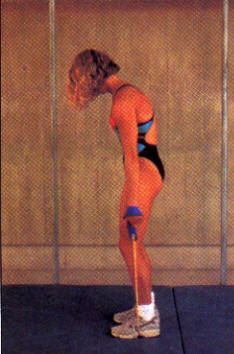
(For lower muscles.) Adjust the rope length so that when you bend your knees you can hang from your hands. Be able to release all stretching force if you stand up. Stretch for about two to three minutes.
2. Standing Stretch
(For upper muscles.) Place one sling on each wrist. Stand on the rope. Adjust the rope length so your lower back is straight during these stretches. To stretch press your toes and straighten the upper chest. This will stretch the muscles at the top of the shoulder blade and the base of the neck. If you hunch the upper chest forward and press up you will stretch the muscles farther over onto the back (rhomboids). Do both positions for one-and-a-half to three minutes.
3. Chin Stretch

(For posterior muscles.) This stretch will move your shoulder around under your chin. Attach the rope just below shoulder height. Place a sling on one wrist. Lean away from the point of attachment of the rope. It may take up to 45 seconds before you begin to feel the shoulder blade muscles on your hack stretch so be patient. Keep shoulder joint muscles tight enough to prevent shoulder dislocation. Stretch left and right side for one-and-a-half to two minutes each.
4. Forward Stretch
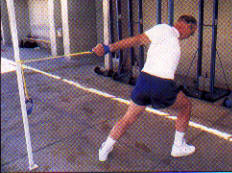
This stretches the muscles that move the shoulder blade forward (pecs and serratus anterior). Lean forward and rotate the arm to the position that feels most stable. Press forward. Arch the chest forward to increase stress on the pectoral muscles. Stretch left and right side for one-and-a-half to three minutes each.
5. Chicken Wing Stretch
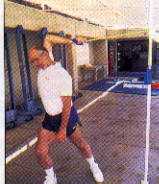
This increases rotation of the shoulder blade to allow the arms to come closer together behind the head. Stretch each side for one-and-a-half to two minutes so stress goes to the muscles of the shoulder blade and not to the shoulder joint.
6. Streamlining Stretch
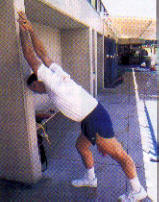
Place your hands high above your head and lean against the wall. See if you can comfortably move your arms well past the ideal streamlined position. Stretch for one-and-a-half to two minutes.
Now test time! Again place your arms in the streamlined position above your head and compare this with what you looked and felt like before you began stretching. You should notice some difference after one session.
Marty Hull is a top Masters swimmer and a consultant to the Stanford University Swim Team.